Tag Archives: Syntex

Microsoft 365 SharePoint Archive: deep dive

Microsoft announced SharePoint Archive in 2023 and make the feature generally available in Apr 2024. Though there are good Microsoft’s articles on how to enable and configure SharePoint Archive, as well as some FAQ pages, there are still a lot of questions regarding behavior details, e.g.

  • what happens with Team content if the group-based site is Archived
  • is there an API or how do we archive/restore sites programmatically
  • would MS Graph Search API work for archived sites

I have just activated the feature and I’m planning updating this page with my gotchas and findings…

Why Archive?

  • If the site is not used, but you are not ready to delete it (or cannot delete it for compliance) – you can save money on storage by archiving site.
    – Regular SharePoint Storage = $0.2 per GB per month
    – Archived Storage = $0.05 per GB per month

Reactivation fee

How much is to restore a site from Archive?
Microsoft says restore is free within 7 days. After 7 days it’ll cost $0.6 per GB.
In the example below Microsoft charges me $1 to restore a simple OotB site with no documents:
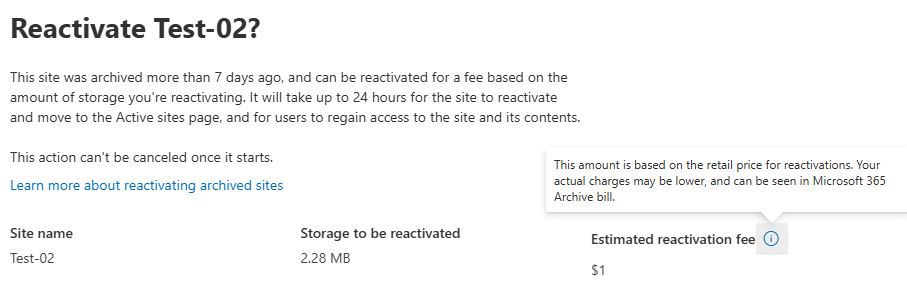
This amount is based on the retail price for reactivations. Your actual charges may be lower, and can be seen in Microsoft 365 Archive bill

Microsoft says “This amount is based on the retail price for reactivations. Your actual charges may be lower, and can be seen in Microsoft 365 Archive bill.”
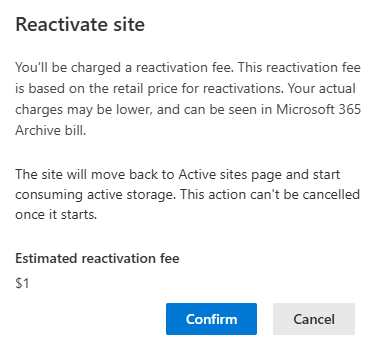
Reactivate site. 

You'll be charged a reactivation fee. This reactivation fee is based on the retail price for reactivations. Your actual charges may be lower, and can be seen in Microsoft 365 Archive bill.

The site will move back to Active sites page and start consuming active storage. This action can't be cancelled once it starts.
Estimated reactivation fee
$1

Another confirmation is requested:

Reactivate site.

You’ll be charged a reactivation fee. This reactivation fee is based on the retail price for reactivations. Your actual charges may be lower, and can be seen in Microsoft 365 Archive bill.

The site will move back to Active sites page and start consuming active storage. This action can’t be cancelled once it starts.
Estimated reactivation fee
$1

Reactivation request submitted
It will take up to 24 hours for the site to reactivate and move to the active sites page

After a few days I saw cost “<0.01$”

===========

To be continued…

What if you get “The site is archived” message?

In 2024 Microsoft announced general availability for it’s new SharePoint Archive feature. So if you are seeing “The site is archived” and “A SharePoint Administrator archived this site. If you need access, ask an admin to reactivate it.” and the page in your browser is “sharepointerror.aspx?scenario=SiteArchived” then… guess what… your site was archived.

Why it becomes a big deal? In 2025 Microsoft started archiving OneDrive sites belonged to unlicensed users for more than 93 days.So, for OneDrive sites – even if your OneDrive retention period is longer – if you restore the site from the sites recycle bin, the OneDrive will gets archived. To unarchive – you have to have a billing configured (as it’s pay as you go feature). So if you want to restore OneDrive from a recycle bin – ensure you assign license to the user before restoration. Or you have to pay for unarchiving.

If you need this site – please do as soon as possible, as reactivating the site within 7 days is free, otherwise it might cost your company some dollars:

  • Reach to your SharePoint admin and
    • Share with admins the original site Url (actual site you want to unarchive),
      like this: “https://yourtenant.sharepoint.com/teams/MySite
      as the page “https://yourtenant.sharepoint.com/_layouts/15/sharepointerror.aspx?scenario=SiteArchived” is just a general system page that displays the archival message.

Bug or feature?

Though the page Url is “https://yourtenant.sharepoint.com/_layouts/15/sharepointerror.aspx?scenario=SiteArchived” and the page title is “Error” – this is not a bug, but just a new SharePoint feature 🙂