This article is for SharePoint or Microsoft 365 admins focusing on governance and information protection. If you have SharePoint Advanced Management (SAM, aka SharePoint Premium) licensed or you got at least one Copilot for Microsoft 365 license (as having m365 Copilot license automatically enables SharePoint Advanced Management in tenant), then under reports – Data access governance (in SharePoint admin center) – you can not only get Content shared with ‘Everyone except external users’ (EEEU) reports, but also initiate access review. Let us look more closely at this functionality and discuss the pros and cons..
First of all, report does not provide you with all SharePoint content shared with “Everyone except external users”. Report helps you with what was shared with EEEU in the last 28 days. That drastically limits usage of this feature. I.e. you should first get initial report on the all content shared with EEEU, and somehow take care of it by other means (consider How to Find Content Shared with Everyone in SharePoint and Teams), and only then you can use this Microsoft’s content shared with EEEU report and access review.
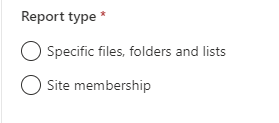
You can share content with EEEU or directly – by adding EEEU to resource permissions directly or by including EEEU into SharePoint group. So content shared with EEEU reports come in two flavors – “Specific files, folders and lists” and “Site membership”
“Specific files, folders and lists” user experience
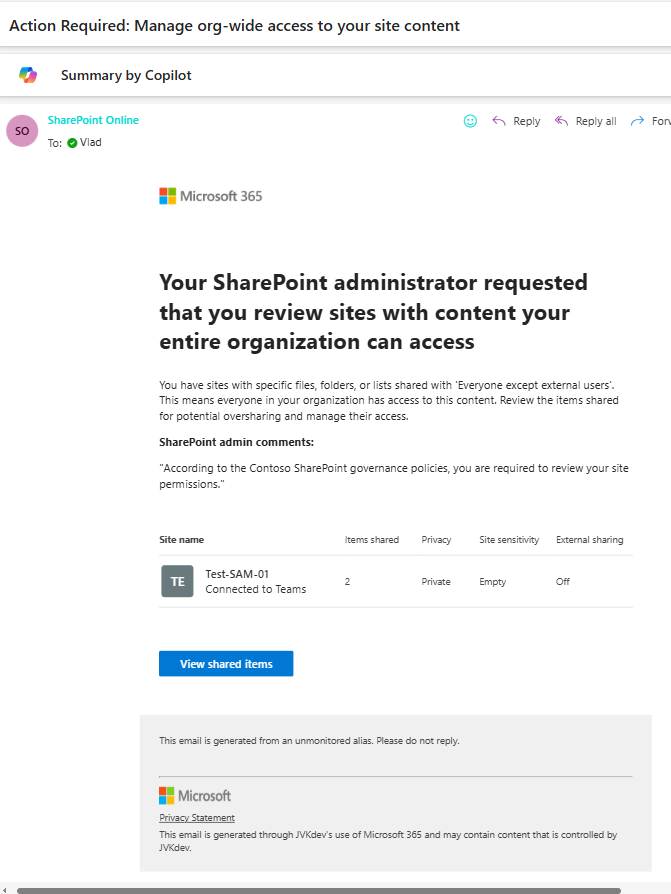
When you initiate access review from the “Specific files, folders and lists” type of report – users (site admins/owners) get email notification that says “You have sites with specific files, folders or lists shared with ‘Everyone except external users’. This means everyone in your organization has access to this content. Review the items shared for potential oversharing and manage their access.“
Scrolling down, in the email, site owner can see a list (table) of incompliant sites with the following columns: Site name, privacy, sensitivity, external sharing and “Items shared”. Site name is clickable and sends user to the root of the site.
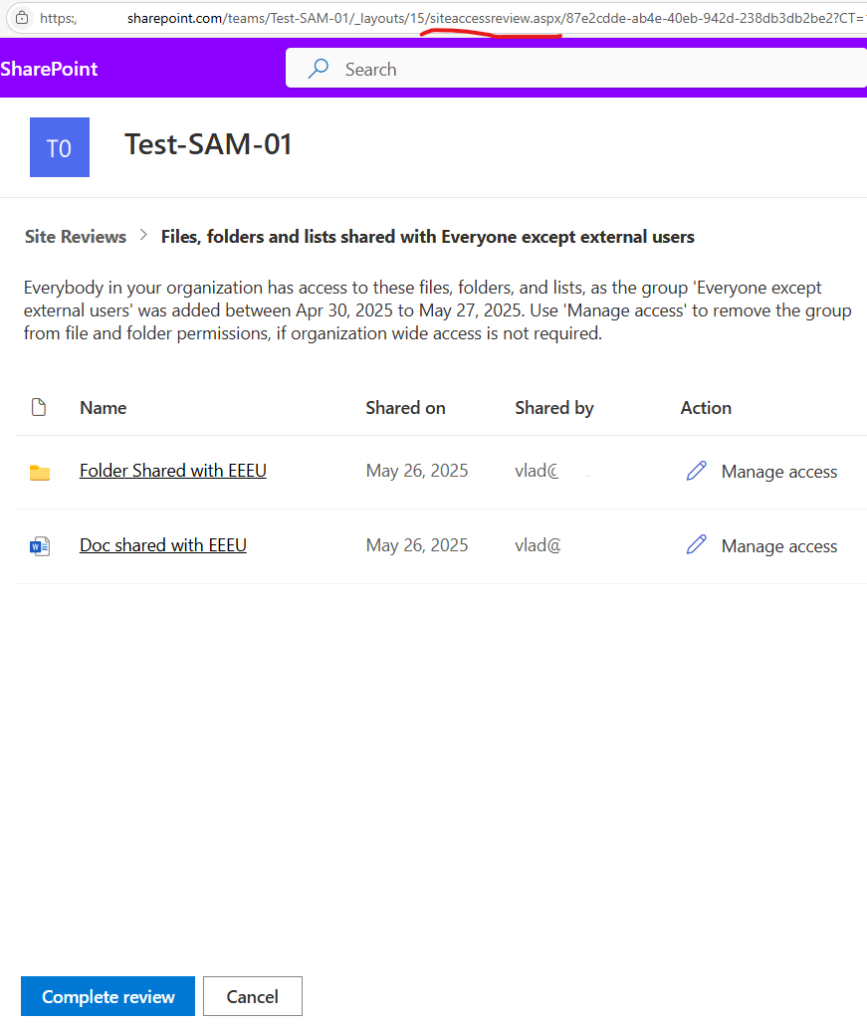
Below the list of sites there is a button “View shared items” that sends user to the special system page – “https://orgname.sharepoint.com/teams/site01/_layouts/15/siteaccessreview.aspx/<id>” where he/she can see list of SharePoint items shared with EEEU. Columns are: (item) Name, Shared on (date), Shared by (email), Action (manage access). Item name and manage access are clickable.
If an item is a library item – e.g. document or a folder – it is displayed correctly – with icon according to the doc type and doc name. Clicking on the doc name – an actual document opens so you can review it’s content.
If item is a list item – it is displayed incorrectly – no icon, no meaningful info about the item (it is displayed as “”). Clicking on the link – a warning icon and message “Can’t preview this file. Open the file or download it to view in your desktop app”. Buttons “Open” and “Download” are there but not helpful as well.
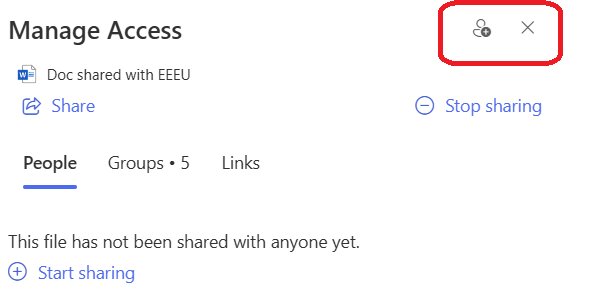
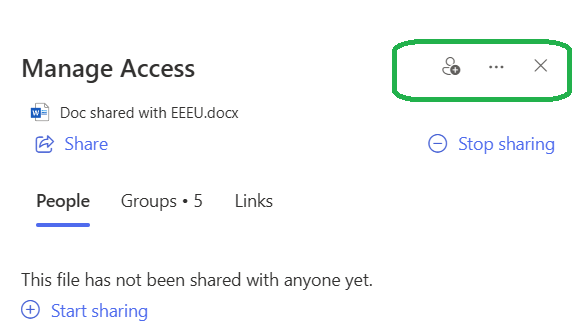
Clicking on “Manage access” opens almost standard “Manage access” dialogue you can have via “manage access” item context menu, but with no “…” more options at the top right:
which makes this dialogue screen useless, as you can only provide additional access to the item or remove all access. You cannot remove EEEU from access without three dots “More options”.
Manage Access from the Policy:
Regular Manage Access:
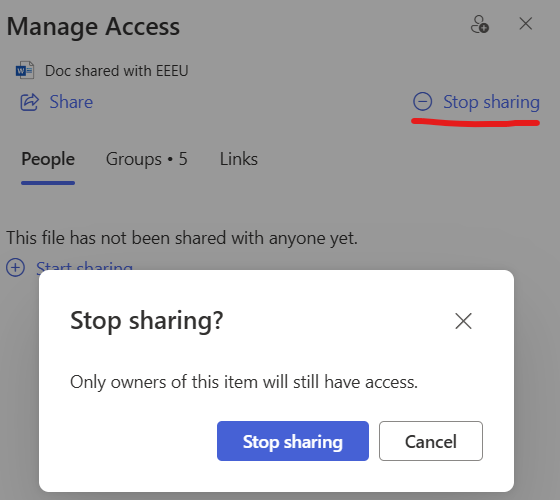
“Stop sharing” literally removes all permissions to the item except owners
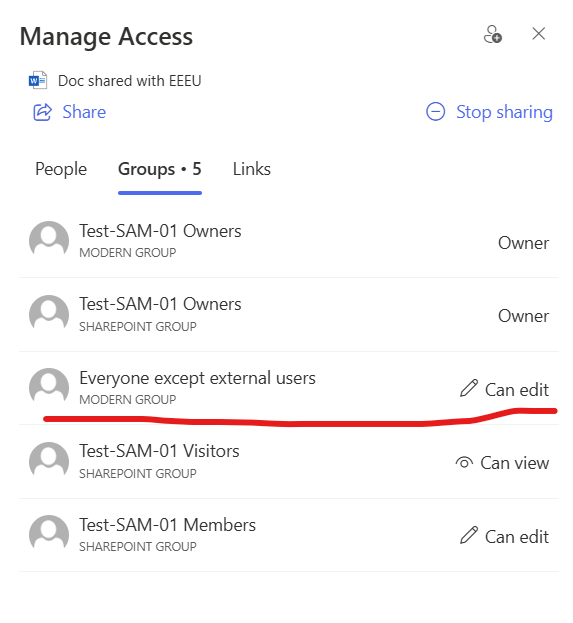
Under the “Groups” tab – you’d see that the item is shared with “Everyone except external users” but you will not be able to remove just this group from access…
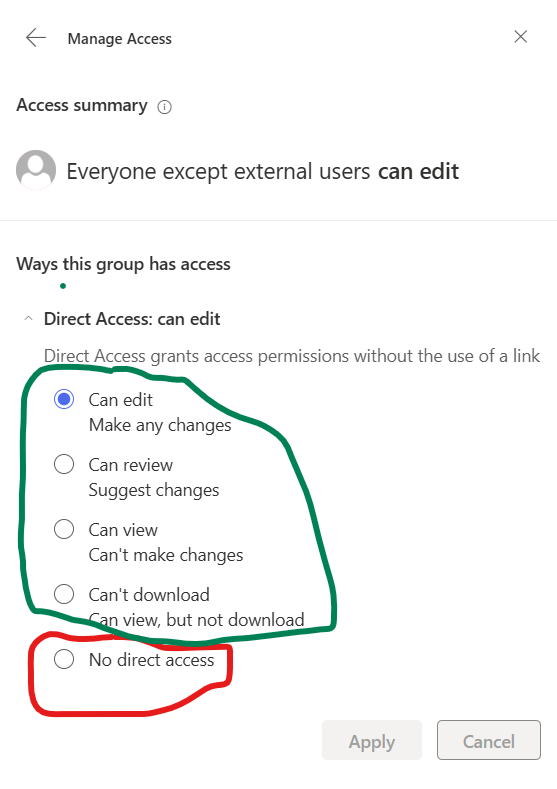
By clicking on a group name – site owner will be able to change this group permissions, but the option “No direct access” is not selectable…
“Site membership” user experience
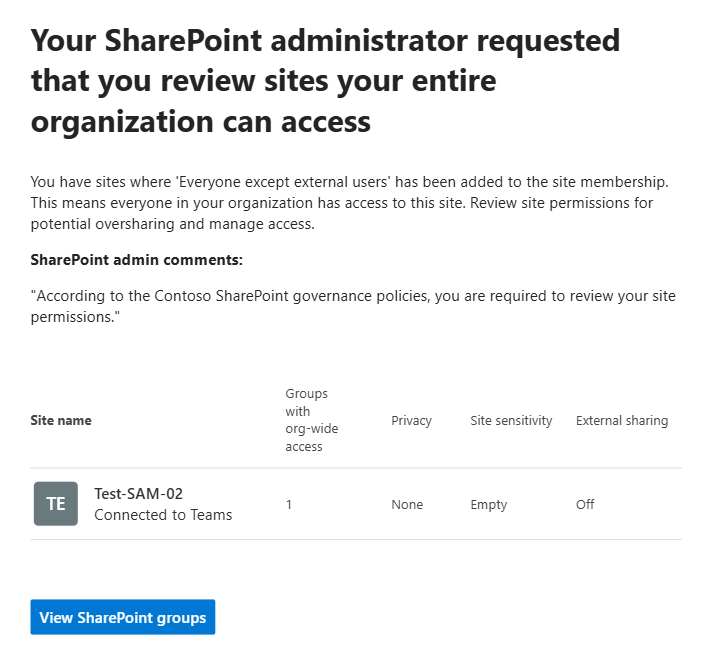
In the case with a “Site membership” report, text would be slightly different: “You have sites where ‘Everyone except external users’ has been added to the site membership. This means everyone in your organization has access to this site. Review site permissions for potential oversharing and manage access.“, which makes sense.
Right after that, in the email, site owner can see a list of incompliant sites with the following columns: Site name, privacy, sensitivity, external sharing and “Groups with org-wide access”. Site name is clickable and sends user to the root of the site.
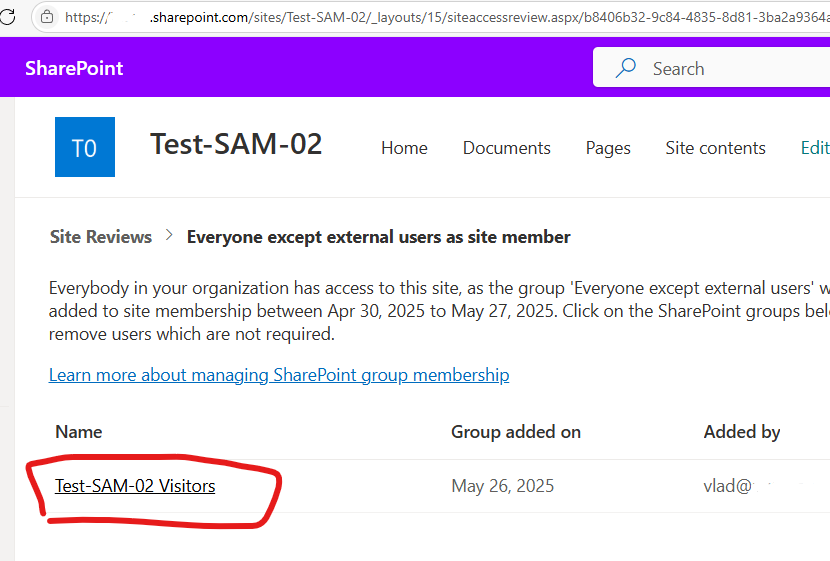
Then there is a button “View SharePoint groups” that sends user to the special system page – “https://orgname.sharepoint.com/teams/site01/_layouts/15/siteaccessreview.aspx/<id>” where he/she can see list of SharePoint groups (clickable) with EEEU as members.
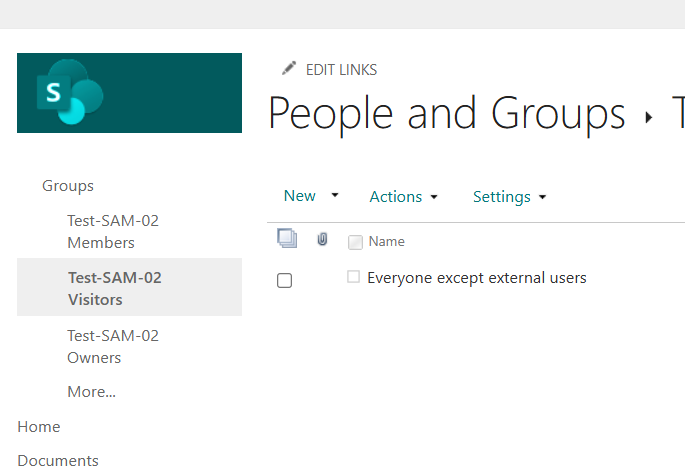
By clicking on a group name – admin opens standard SharePoint “People and Group” membership page: /_layouts/15/people.aspx?MembershipGroupId=X, which is nice, because from this screed a site owner can simply remove this group from the access list using Actions-> Remove:
siteaccessreview.aspx page
User can navigate directly to the reviews page: “https://orgname.sharepoint.com/teams/site01/_layouts/15/siteaccessreview.aspx” and if there were reviews initiated by SharePoint admins – and it’ll work – admin will see all access reviews initiated for this site – columns are: Review name, Description, Requested on (date), Status, reviewed by (email) and admin comment. In case no reviews were initiated against tie site – “You have no reviews to take action on” will be displayed. That’s good.
Complete review
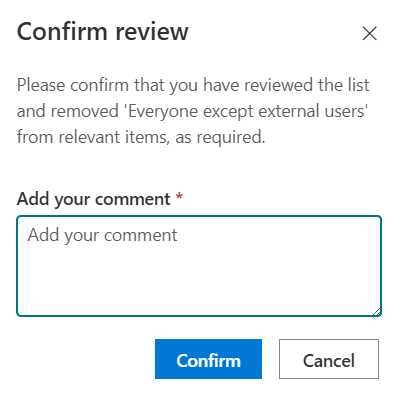
On the bottom of the siteaccessreview.aspx page you’ll see “Complete review”
Click on it, add comment (optionally) and confirm:
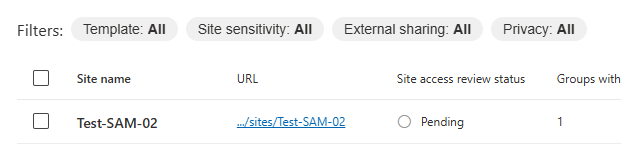
SharePoint Admin is able to see the status of every site access review stats – pending or completed – in GUI and in the .CSV report saved.
Admin experience: GUI only
Once you got report – you can initiate access review. All must be done in GUI, click-click-click selecting sites… But what if you have thousands? There is no PowerShell cmdlets or API for this functionality, which really limits your ability to implement it gracefully, especially in large Microsoft 365 environments and automate it.
Download detailed report
Report “Specific files/folders/lists…” does not include files, folders, list – i.e. it does not include what exactly is shared with EEEU. Report includes site id, url, name, template, is it teams-connected, sensitivity (?), privacy, external sharing, primary admin name and email, and number of items (?) shared with EEEU.
So technically you can communicate to site owners, but you’d need to rely on them to figure out what content is shared with everyone.
Email template
When you initiate Site access review – an e-mail notification is send to site owners. This e-mail is not customizable at all. The only admin can do is to add a message (for every “initiate Site access review” action). But the email looks really similar to the site lifecycle policies email notification, and Microsoft is working on version 2 of the policies with a customizable email template.
This email comes from “SharePoint Online <no-reply@sharepointonline>” address (not customizable), so comes “from outside of your organization” and can be considered as scam.
Microsoft’s logos and other graphics are blocked by default and e-mail includes a button “View shared items” – enough red flags for users to consider it as spam. Keep this in mind.
The good news is e-mail contains site name – so site owner can recognize it at act accordingly.
Usage scenarios
Small tenants
In small Microsoft 365 environments – yes, this functionality probably can be used “as is” (and should be used). Especially for new tenants – I’d recommend enable reports and use this feature on a regular basis.
Medium-size tenants
I’m not sure. It depends on your governance rules and company culture.
Enterprises would not like it
I’m very pessimistic if this functionality is useful in large environments. Reasons are:
In enterprises usually all the communication must follow approved templates, branding and so on. Currently SAM DAG does not support custom templates (though there are rumors Microsoft is working on it)
User experience of “reviewing shares with everyone”… and “managing permissions” designed very poorly… You SharePoint users need clearness and simplicity. Existing UX makes everything wort. In enterprise you do not want to deal with thousands of tickets from site owners who could not figure it out
In enterprises you’d think of automation. Currently all is just GUI.
if your tenant is not new – you already have a lot of overshared content. This functionality covers only new shares, so you still need to come up with your custom solution (idk – PowerShell scripts?) to deal with oversharing. But once you designed your custom solution – why don’t you continue to use it?
SharePoint Advanced Management is an add-on to Microsoft 365 for admins. Microsoft says that it is a powerful suite of tools for IT admins to bolster content governance throughout the Microsoft Copilot deployment journey. Let us have a closer look at what SharePoint Advanced Management (SAM) is how exactly it helps with governance enforcement in the Copilot era.
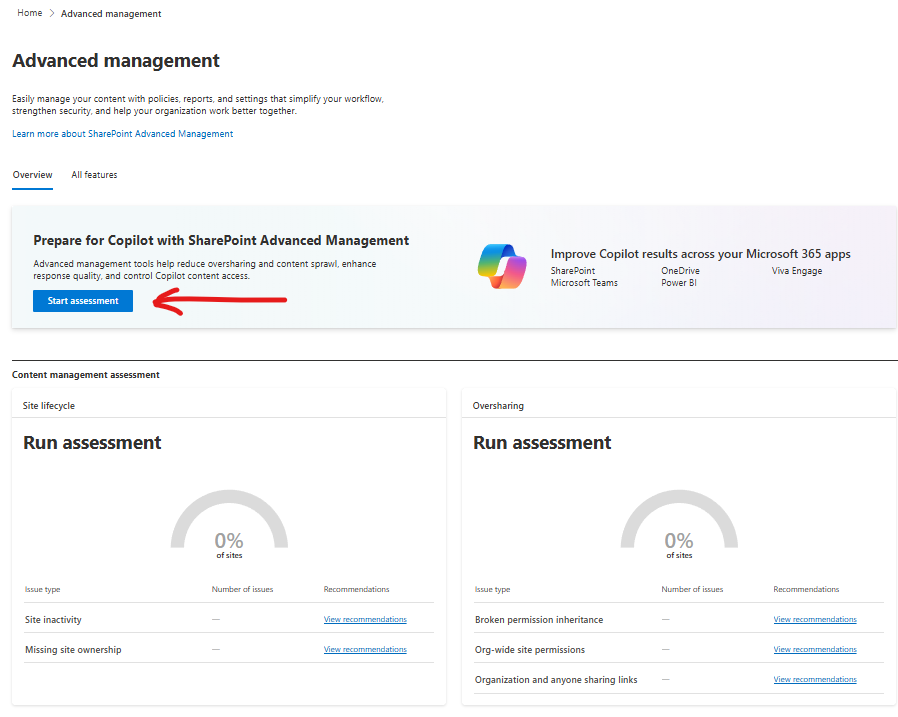
Microsoft recently updated SAM features (this KBA is based on Oct 2025 features set). Now Advanced management page has a dashboard – “Overview” tab and “All features” tab.
Advanced management – Overview
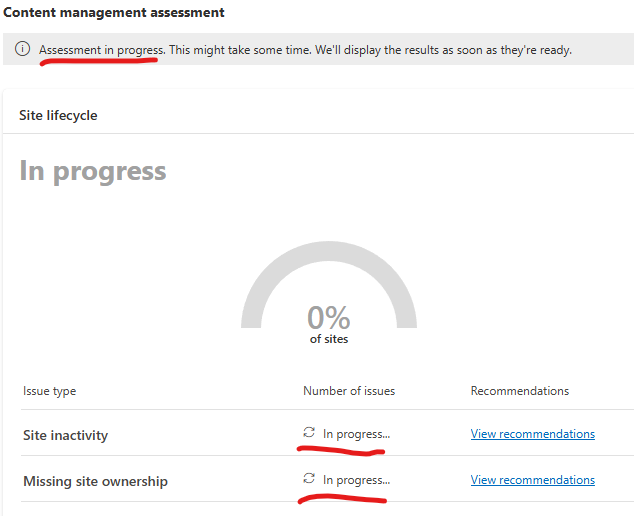
On the “Overview” page Microsoft wants us to run assessment. “Start assessment” button starts assessment immediately. So let us click “Start assessment” button and see what it does exactly. Btw, it might take from days to weeks for your tenant – depending on the tenant size. While assessment is in progress – it’ll display “Assessment in progress. This might take some time. We’ll display the results as soon as they’re ready.”
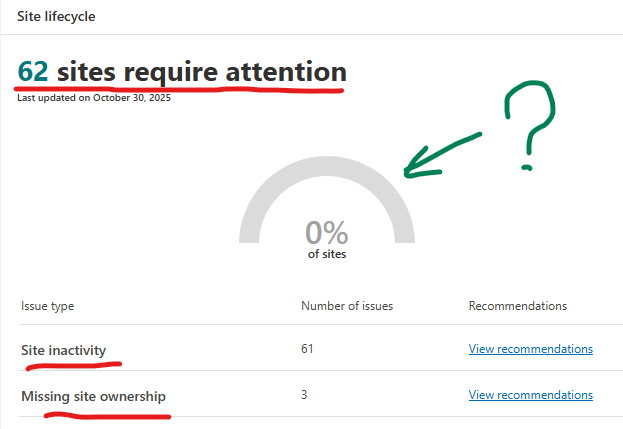
It took 3-4 hours for my small dev tenant to assess Site lifecycle and find 62 sites require attention:
Advanced management – All features
Microsoft classifies SAM’s features as “Manage content sprawl”, “Manage content lifecycle”, “Manage permissions and access”. I’d put SAM’s tools into these buckets: Reports, Policies, Search, Features.
SAM Reports
SharePoint SAM reports provide structured, actionable data that you can analyze to optimize governance strategies and implement immediate improvements. Reports available are:
Agent Insights – how agents are accessing the content on the sites
App insights – review apps registered in Entra allowed access to SharePoint sites
Change history reports – site actions or organization setting changes you can choose org-wide or site-level settings, specify date range, sites and all or specific admins
Content services reports – Term store, term sets and terms
Data Access Governance (4 different ones)
Site permissions across your organization
Sharing Links with 3 pre-configured reports: Anyone links, People in your org links and Specific People links shared externally
Sensitivity labels applied to files: select label -> generate report
Content Shared with Everyone Except External Users: to discover specific sites whose content was made accessible for EEEU you can choose from two types of report: where specific files/folders/lists are shared with EEEU or “Site membership” where EEEU was added as a member and initialize access review (see Deep Dive into SAM DAG Content shared with EEEU access review)
OneDrive Accounts report – about unlicensed OneDrive accounts
Site policy comparison – control oversharing by identifying sites with similar files and different policies
SAM Policies
Policies in SharePoint SAM define governance rules that are enforced automatically, minimizing manual intervention and ensuring consistent compliance. SharePoint Advanced Management policies are:
Site Lifecycle management: Inactive Site Policy. Allows:
AI Insights – report feature that uses a language model to identify patterns and potential issues and provide actionable recommendations to solve issues
Features
Features are smaller that policies, more like an update to existing functionality.
Conditional access to SharePoint site policy This enhances existing conditional access Entra Id feature with the ability to apply the policy to SharePoint sites directly or via Site sensitivity label.
OneDrive access restriction
SharePoint site-level access restrictions
Block download policy
Your recent actions
Default sensitivity labels for document libraries
Site access review
SAM for Search
I put it separately:
restrict discovery of SharePoint sites and content
With Microsoft officially announcing the retirement of legacy Azure Access Control Services (ACS), SharePoint administrators are now racing against time. For over a decade, ACS-based permissions—commonly known as SharePoint app-only service principals—have been widely used, with countless tutorials and blog posts guiding users on how to implement them in their applications.
However, many of these ACS-based apps are still actively accessing SharePoint sites. When Microsoft eventually disables ACS, we want to avoid a scenario where critical business processes suddenly break and teams are left scrambling.
To stay ahead of this change, our goal is to identify all app-only principals still relying on ACS to access SharePoint. This includes gathering details about the apps, their owners, the sites they access, and the site owners. The ultimate objective is to proactively reach out to the responsible stakeholders, inform them about the upcoming retirement, and encourage them to migrate their solutions to modern authentication methods.
Below is my deep dive into tracking/inventoring ACS apps, but for those who just want a quick solution – there is a Summary in the end.
Technical details
What kind of apps we are talking about, specifically? I can see the following options:
Apps that were registered in SharePoint via AppRegNew.aspx (aka SharePoint app-only service principals) and provided with permissions in SharePoint via AppInv.aspx
Apps that were registered in Azure (Entra Id) and provided with permissions in SharePoint via AppInv.aspx
Let us start with pulling data, then I’ll provide step by step instructions how to discover App-Only apps, get these apps activity and actions need to be taken.
Techniques we can use to get data
analyze audit log to get events where apps are accessing sites
analyze audit log to get events where ACS permissions were provided to sites
get data from system that tracks request for new ACS permissions
use reports from admin center
use the PnP Microsoft 365 Assessment Tool
get report on apps owners and permissions from from Entra Id
Let us deep dive into each data source to see if it is actually helps us to get ACS apps in use…
Audit log: apps accessing sites
Microsoft 365 audit log is supposed to save all events happening in Microsoft 365. It is available for admins via GUI, PowerShell Exchange Module and Graph API. GUI Search m365 audit log now lives under Microsoft Purview – Solutions – Audit.
Unfortunately, when an App registered in Azure is accessing SharePoint sites – not all events are logged. Here are some of the events that are stored in the Microsoft 365 unified audit log:
Accessing list items:
List Item Viewed
List Item Created
List Item Updated
List Item Deleted
Accessing Documents in libraries:
File Accessed
File Uploaded
File Modified
File Downloaded
File Deleted
Events would have a UserId “app@sharepoint”. Other event details include activity/operation (PageViewed, FileModified etc.), Item (full Url of a document or page etc.), AppAccessContext (includes ClientAppid, ClientAppName), ApplicationId (yes, this is how we know what app access what url on the site), and many other details. When an app fails to access SharePoint – due to expired secret or missing permissions or because ACS is disabled – no events are logged.
Unfortunately, from analyzing audit log events – you cannot say if the App that is accessing SharePoint were provided with ACS permissions (via appinv) or Graph API (e.g. Sites.Selected via Entra Id).
Get Service Principals activity via Microsoft Graph API
The following reports are available via MS Graph API (some as v1.0, others in preview only under beta):
Service principal sign-in activity
This report is available through the servicePrincipalSignInActivity resource type and details the sign-in activity for a service principal in your tenant. The sign-in activity can be delegated or application-only scenarios. For application-only scenarios, the application credential activity provides additional information on the credential usage.
Service principal sign-in activity report provides the following details for every service principal:
This report is available through the appCredentialSignInActivity resource type and details the usage of an app credential (secret, certificate, or federated identity credential) in your tenant.
Application credential sign-in activity report provides the following details for every service principal credential:
Graph API allows you to get Entra Id audit log events, including logins of service principals: Microsoft Entra audit logs API. Microsoft: “Microsoft Entra provides an audit trail of all user and app activity in your tenant to help you track all activities in your tenant and also be compliant. These logs include both app and user sign in activity“. Available under “/auditLogs/signIns”. The only thing is it does not work for us.
First (minor issue) – I could not get app sign in activity under production API (v1.0), only under beta (Feb 2026). The biggest issue is id does not catch events we want it to catch. See the table:
Action
Audit Log Event status, ErrorCode, FailureReason
(ACS enabled) Connect-PnPOnline: OK Get-PnPSite: Failed (secret expired)
Status: Failure errorCode=7000222; failureReason=The provided client secret keys for app ‘{identifier}’ are expired.
(ACS enabled) Connect-PnPOnline: OK Get-PnPSite: OK (secret renewed)
I.e. when ACS is disabled – the app is not able to get site, and no errors in Entra Id audit log…
Microsoft 365 Audit log ACS permissions provided events
This is relatively easy. There are just two kinds of events that might help us to understand ACS usage in tenant:
SharePointAppPermissionOperation
Pull audit logs with record type is SharePointAppPermissionOperation so you’d get events where permissions were provided to apps. Operation type (activity) would be like AppPermissionGrant.
Microsoft started logging this record type not long ago and there is no documentation found (as of Feb 2025). So the only I noticed that might help is:
if user id is “app@sharepoint” – that indicates Sites.Selected permissions were provided to the app (e.g. via Grant-PnPAzureADAppSitePermission ) under “AppId” you’d have an app (client) id of the client app (permissions provided to) in the form of “i:0i.t|ms.sp.ext|<appId>@<tenantId>” under “ApplicationId” and “AppAccessContext – ClientAppId” – you’d have an app (client) id of the admin app (permissions provided via) ApplicationDisplayName would contain the display name of the admin app Other fields: RecordType 205, UserType 5, AuthenticationType OAuth
if user id is one of your actual user’s account in tenant – that indicates ACS permissions were provided to the app (e.g. via appinv.aspx page at SharePoint site) under “AppId” you’d have an app (client) id of the client app (permissions provided to) in the form of “i:0i.t|ms.sp.ext|<appId>@<tenantId>” there would be no “ApplicationId” field and under “AppAccessContext” no ClientAppId ApplicationDisplayName Unknown Other fields: RecordType 205, UserType 0, AuthenticationType FormsCookieAuth
Appregnew.aspx and appinv.aspx pages viewed
You can pull audit logs with record type is SharePoint and activity type (operation) is PageViewed and keyword for free search is appregnew. You’d get events when there was an attempt to register a new SharePoint app-only service principal.
The same but with appinv as a search keyword – to get events when there was an attempt to provide ACS permissions for a SharePoint app-only service principal or for an Azure App registration.
In both cases we know that there was an intention to have a principal with an ACS access. We can reach these people to inform that ACS is deprecated and so and so. Worst scenario – we notify somebody who already know that.
Some time ago (around mid – 2023) Microsoft by default disabled ability for site owners registering apps and providing permissions in SharePoint via Appregnew.aspx and appinv.aspx. So since then only SharePoint service admins could provide ACS permissions to apps. In this case you’d check with your request tracking system – to whom ACS were provided.
System that tracks request for new ACS permissions
In case you have a process of providing ACS permissions… Process might include tickets to service desk or similar kind of system… Anyway – check if you can get data from that system – like who requested for what app to what site etc…
Reports available from Microsoft 365 Admin Center
So far the only report that might help is in development (see Microsoft 365 Roadmap – feature Id 417481) and scheduled to be available in May 2025. So far (July 2025) what I can see is the report is not working.
“Enterprise Application Insights is a powerful report which helps SharePoint Administrators to discover all the SharePoint sites that are allowed access by third-party applications registered in your tenant. The report also provides details on the application’s permission and requests count to help admins take further action to strengthen the security of the site. It is part of SharePoint Advanced Management capabilities.”
The feature is already documented here: Generate App insights reports and is seems like the report will not be available for all tenants – but just for tenants with Microsoft SharePoint Premium (SharePoint Advanced Management) or Copilot license assigned.
PnP Microsoft 365 Assessment Tool
Microsoft 365 Assessment Tool is an utility designed by PnP team a while ago and since then serves SharePoint admins very well. In particular, it helps us identify and evaluate the Azure ACS usage for tenant by providing the usage data of ACS principals, and even generating a Power BI reports.
If you run this tool specifying AddInsACS mode, it provides you with:
classicacsprincipals.csv report that includes all apps with access to SharePoint. Details are: App Ids, if the app has Tenant or Site Collection Scoped Permissions, if the app Allows AppOnly, RedirectUri, AppDomains and ValidUntil If the ValidUntil field contains specific date – that means the app was registered via appregnew If the ValidUntil field contains “01/01/0001 00:00:00” date – that means the app was registered in EntraId if the AllowAppOnly field equals TRUE – that means ACS permissions were provided to the app
classicacsprincipalsites.csv – report contains apps and sites they have access to Details are: AppIdentifier, ServerRelativeUrl
classicacsprincipalsitescopedpermissions.csv – list of apps permissions to sites Details: AppIdentifier, ServerRelativeUrl, SiteId, WebId, ListId, Right (Read/Write/FullControl/Guest etc.) If the WebId field equals zeros, that means permissions were provided to entire site collection
classicacsprincipaltenantcopedpermissions.csv – list of apps with tenant-wide permissions
some other reports, like list of sites, list of webs
Unfortunately, this tool does not provide when the app was last time authenticated or when the app accessed the site. Also, we do not know what kind of access was provided for the app to the site – Sites.Selected or ACS. If at least one access provided for the app was ACS-based – the app will have AllowAppOnly field equals TRUE.
Report on apps owners and permissions from from Entra Id
Using all the methods above – you’d get a list of active service principals that use legacy ACS authentication. But to whom we need communicate to regarding this service principals? Obviously, we are looking for these service principals owners and sites owners.
There are multiple options how to get an app owner from Azure (Entra Id):
So you’ll get a list of legacy apps sorted by recent activity. These apps need to be decommissioned. There should be no one App-only service principal or app registration (client id) with legacy ACS permissions provided in tenant.
Communicate to apps owners and site owners
Once you get a list of legacy (ACS/App-Only) apps – pull report on these apps owners. Having “classicacsprincipalsites.csv” report from m365 assessment tool – you can pull site owners for every app you need to decommission. This is a big topic itself. See details in my article How to prepare your tenant for Azure ACS retirement – Guide for SharePoint Admins
More Observations
Test scenario 1 DisableCustomAppAuthentication is true, i.e. ACS are not allowed in tenant. SiteOwnerManageLegacyServicePrincipalEnabled -s false, i.e. site owners cannot register apps at sites or provide permissions to app on sites. It is not possible for admin to go to appregnew.aspx and create an app (app-only spn). I registered apps in Azure. It is possible for admin to go to appinv.aspx and “provide” permissions to the azure app registrations.
Connect-PnPOnline works with certificates or with secrets. Get-PnPSite works only if connection was made with a Certificate (if connection was made with secret – it gives 401 unauthorized).
Test scenario 2 DisableCustomAppAuthentication is false, i.e. ACS are allowed in tenant. SiteOwnerManageLegacyServicePrincipalEnabled -s false, i.e. site owners cannot register apps at sites or provide permissions to app on sites. Connect-PnPOnline and Get-PnPSite works with certificates or secrets if ACS access was provided for an app to at least one site. If there was no ACS permissions provided for the app – Get-PnPSite gives “Access is denied. (Exception from HRESULT: 0x80070005 (E_ACCESSDENIED))”
Error messages and possible fixes
“Access is denied. (Exception from HRESULT: 0x80070005 (E_ACCESSDENIED))” – happens if you try to access SharePoint API with an Entra Id app registration that have an API permissions but do not have legacy ACS permissions being authenticated with a secret. Solution option 1: try authentication with a certificate. Solution option 2: use Microsoft Graph API.
“The remote server returned an error: (401) Unauthorized.” – happens if you try to access SharePoint API being authenticated with a certificate with an app registration that do not have modern API permissions correctly provided. Solution: ensure app registration is configured with SharePoint API permissions.
“(403) Forbidden” – happens if you try to access SharePoint API being authenticated with a secret with an app registration that do not have modern API permissions correctly provided. Solution: ensure app registration is configured with Graph API permissions.
“AccessDenied”,”Either scp or roles claim need to be present in the token.” – happens if you try to access Graph API being authenticated with a secret with an app registration that do not have modern API permissions correctly provided. Solution: ensure app registration is configured with Graph API permissions.
Get-MgServicePrincipal
Get-MgServicePrincipal returns servicePrincipal objects with properties and relationships. ServicePrincipalType = ‘Legacy’ indicates service principal was registered in SharePoint (via appregnew.aspx).
An issue with ACS apps discovery when Graph permissions also provided
There was an issue (before late June 2025)
How do we know the ACS permissions are provided for the app to the site? Two great options: appprincipals.aspx and Microsoft 365 assessment tool by PnP.
An app is shown under appprincipals.aspx only in case if ACS access was provided to app but Sites.Selected access was not provided. The moment you provide Sites.Selected access for the app to the site – the app disappears from list of apps under appprincipals.aspx page. The app is not visible for Get-PnPAzureACSPrincipal. PnP M365 Assessment Tool also fails to get list of ACS apps if the site also has Sites.Selected permissions. It does not help if you remove Sites.Selected permissions. This issue is reported to Microsoft and confirmed. Microsoft is working on it. Upd (June 2025) – Microsoft implemented fix, so all should be good now (but if you are seeing “Sorry, something went wrong” trying to access appprincipals.aspx – just wait, they said db needs to be updated as well, it takes time).
A fix, current state and changes
Microsoft deployed a fix and updated databases. So starting July 2025 we can see all apps (legacy, modern, with ACS and with Graph permissions assigned) under appprincipals.aspx page. The good is we finally can see apps, the bad is we cannot differentiate – is this an ACS app or app with permissions provided via Microsoft Graph, also we cannot see permissions.
Microsoft 365 Assessment Tool does a good job, detecting if the app allows App-Only permissions (AllowAppOnly equals true in the report classicacsprincipals.csv). Under reports classicacsprincipalsites.csv and classicacsprincipalsitescopedpermissions.csv, the tool provides what sites every app has access to and what permissions the app has, but again, it does not provide details if permissions were provided with ACS or Microsoft Graph.
Summary
use Microsoft 365 assessment tool to get list of apps with ACS permissions provided. It also gives you report on ACS apps and sites, and apps-sites-permissions.
use Graph API or PnP to get owners of active apps – so you can communicate to owners
AFAIK, generally, for apps with both kinds of permissions provided Entra Id and ACS permissions – we cannot establish for sure if the app is actually using ACS access or not. We only can say that ACS permissions were provided to the app and the App is still active.
If there are no Entra Id permissions provided to the app and app is still actively using SharePoint – that means that this app is leveraging ACS and very soon will stop working.
Microsoft has announced the retirement of Azure ACS, and as SharePoint administrators, we must take action. The retirement of ACS is a significant change – an entire era of SharePoint app‑only service principals will come to an end. SharePoint developers have relied on ACS‑based applications since 2013 to build custom solutions, and in software development, change always takes time. Code originally designed around ACS must now be reviewed and refactored to accommodate new authentication models, then recompiled, retested, and redeployed. Because of this, it is critical that organizations begin remediation efforts now to reduce risk and avoid major operational issues leading up to April 2026.
Another at‑risk group is data analysts. During an earlier phase of Azure Data Factory (ADF) adoption, ACS‑based applications were required, which means a significant number of long‑running data pipelines may still rely on ACS for authentication.
3 weeks before ACS EOL
If you have only recently learned that Microsoft’s Azure ACS–based (classic) app connections to SharePoint will stop working in a matter of weeks, and you are trying to determine whether you or your clients will be impacted, you may not have time to follow a detailed, step‑by‑step remediation guide below I shared ~ year ago. In that situation, one practical option is to conduct a controlled “scream test.” I have been working with ACS for many years and have been preparing a large tenant for ACS retirement since 2024. Based on that experience, the following are the essential lessons and recommendations that matter most when time is limited.
The PnP team has done excellent work with the Microsoft 365 Assessment Tool. It provides visibility into applications with ACS enabled at both the site and tenant levels, including details about which sites an application has permissions to. However, the raw output is only the starting point. Administrators still need to analyze audit and sign‑in logs and correlate the data to determine which ACS applications are actually active. In practice, this often reveals two additional layers of complexity: not all ACS‑enabled applications are currently in use, and not all active applications necessarily rely on ACS for authentication. The next challenge is identifying the appropriate application and site owners and communicating the required remediation steps. At this stage, communication is frequently ignored or overlooked. This highlights a critical gap—the operational distance between the M365 Assessment Tool output and an application owner taking concrete action. Bridging that gap requires time, coordination, and sustained follow‑up.
An alternative approach is a “scream test”—a controlled, temporary disablement of ACS at the tenant level. This is a significantly faster way to surface unresponsive, unknown, or otherwise disengaged application owners whose solutions are still affected by ACS retirement. In many cases, only an actual service disruption creates sufficient urgency for owners to prioritize migration to modern authentication. This approach does involve risk, as it may temporarily impact existing workloads or data pipelines. However, that risk is justified and, in practice, necessary to identify applications that still rely on ACS—even though they should have already been migrated. Without this step, such dependencies often remain hidden until Microsoft enforces the change, at which point remediation becomes reactive rather than controlled.
Recommended transition tactics: for developers
Get a new App Registration in Azure (Entra Id) with Sites.Selected permissions, ensure no ACS permissions provided to the app (see details on Sites.Selected) and use it
Prioritize using Microsoft Graph API
If Graph API does not provide required functionality – it’s ok to use SharePoint API, but keep in mind in this case certificate should be used (not secret) for authentication
Recommended transition tactics: for SharePoint admins
High-level recommended steps are:
Keep saving audit logs
Encourage users and developers to register applications in Azure (not in SharePoint)
Start providing Sites.Selected permissions
Disable ability for site owners to use AppRegNew and AppInv Stop registering service principals via AppRegNew and providing ACS permissions via AppInv
Pull report on existing Apps that use ACS permissions
Notify developers and users of the ACS apps
Switch ACS off earlier than Microsoft
Thinkin on devs – keep in mind: – ACS apps have a huge legacy – tons of articles and code examples and so on… – Switching to a modern authentication method would require changes in code (though minor, but still), so developers must be engaged – Any change in code would require another round of code compilation, testing, deploying etc.
That means it is not easy (sometimes it is not even possible) to adopt a new modern authentication method. It requires efforts and time, so you need to notify dev as earlier as possible. So it is crucial to complete steps above and start communicating to users as earlier as possible.
Detailed steps for SharePoint administrators:
Keep audit logs
This should be done in advance, but if you did not – starting today and until it’s over you’d get audit logs from Microsoft 365 purview center – consider selecting all events with record type SharePointAppPermissionOperation. Also might be helpful to keep events anyone visited appinv.aspx or appregnew.aspx page. Pull logs now starting with earliest available event (usually 90 days). Some audit logs are available only through Microsoft Graph API. See more details regarding audit logs for ACS tracking KBA.
Encourage users registering applications in Azure (not in SharePoint)
Creating App Registrations in Azure is usually not what SharePoint admins do. Sometimes users are allowed to register apps, sometimes it is blocked for a regular user and done by identity management (or so) but the main idea – users and developers should be able to get service principals (App Registrations) in Azure. Users would need Sites.Selected permissions consented (see more about Sites.Selected) or granular permissions consented (more on granular permissions to SharePoint).
Some pro’s of App Registered in Entra Id (vs SharePoint App-only service principals): – It supports authentication with client secret and/or certificate, custom expiration time – It supports both APIs – Microsoft Graph API and classic SharePoint REST API
Be prepared to instruct users how to get and use certificates in their app registrations.
Provide Sites.Selected permissions
99% of requests for application permissions to SharePoint would require access to a specific site (sites), or to a specific list/library/folder/file (but not to entire tenant). So consider providing Sites.Selected permissions by default (or granular permissions when they are in GA). Create a process so users can request permissions to SharePoint sites for their Azure-Registered Apps. Consider automation if you are a large company (here is one of the possible Sites.Selected automation solutions).
Inform user that ACS is deprecated and you do not provide any new ACS permissions.
Disable registering new service principals in SharePoint
Once you are good in providing non-ACS permissions, it’s time to disable registering service principals in SharePoint. Users should not be able to get a new SharePoint App-only service principals (apps that they used to get from SharePoint sites just going to AppRegNew.aspx).
Disable ability for site owners register service principals in SharePoint via appregnew.aspx is done via Set-SPOTenant PowerShell cmdlet:
When the value is set to false, the service principal can only be created or updated by the SharePoint tenant admin. Using AppInv.aspx page will also be disabled for site owners. Your users will start seeing “Your SharePoint tenant admin doesn’t allow site collection admins…” message (see details), but that’s ok.
There might be rare cases when your in-house solutions or 3-rd party apps got their secrets expired and would require new legacy ACS-based permissions, it is tempting to allow ACS permissions as an exception (as technically it is possible for SharePoint service admin to provide ACS-based access to sites), but I would strictly discourage you to do so. If you decide to provide ACS – track this activity (so you know for whom this ACS-based permissions were provided).
Pull report on existing ACS Apps that use ACS permissions
You need to know who are your vulnerable clients – you should pull reports to get a list of existing Apps that use ACS permissions, apps owners, maybe sites these apps have access to and sites owners
You can get list of developers combining – audit log data from Admin Center and Graph API – report from Entra Id on apps and owners – report from SharePoint sites on permissions provided for apps – reports generated by PnP Microsoft 365 assessment tool
Consider the following steps to get ACS apps owners
get ACS apps with permissions using Microsoft 365 assessment tool
pull these apps owners from Entra Id
using Graph API audit logs data – mark apps active/inactive based on date of the latest login
Notify developers and users of the ACS apps
From the step above we can have a lost of legacy ACS apps and their owners, as well as apps activity (last login), so we can start communicating developers (app owners):
As earlier as possible – e.g. in March-April 2025 (1 year before ACS EOL), notify all apps owners that they need to transition to Azure apps and Selected permissions
Get ACS apps activity and repeat communication, including active app owners
Get ACS apps activity and repeat communication, including owners of sites apps still have access to
Communicate to all apps owners that there will be a temporary and permanent shut down of ACS (see below)
I case you have ACS apps with tenant-level permissions – communicate to them separately
Switch ACS off earlier than Microsoft
You need to plan actual ACS apps disablement in tenant in advance – earlier than Microsoft will do it (though Microsoft can decide put it off). Also consider temporary switch off ACS (“scream test”) even earlier, let say, starting January 2026.
Temporary and permanent ACS disablements before official ACS EOL are needed as scream tests – in case there are irresponsive app owners who ignored all communications and still use ACS apps. Disabling ACS early may cause problems with existing applications, but it is necessary to avoid more serious consequences when the time comes for Microsoft to turn it off. So be prepared to handle tickets and communicate to apps owners in advance.
There are might be cases when software was developed by somebody else and current app owners simply does not know – if the app relies on ACS or not. So scream test – temporary switching off ACS might help owners to understand if the app uses ACS or not.
This might be your draft plan:
schedule the first temporary 30 minutes ACS apps disablement ~3 months before EOL
schedule the second temporary 2 hours ACS apps disablement ~2 months before EOL
schedule the 3rd temporary 24 hours ACS apps disablement 6 weeks before EOL
schedule the full (permanent) ACS apps disablement ~4 weeks before EOL
Restricted SharePoint Search is a new Microsoft feature to mitigate sites oversharing issue when you are implementing Copilot. The feature is documented here, but still I have some questions, e.g.:
How about external data? Copilot can use external data to learn from via agents and connectors. But would Restricted SharePoint Search if implemented allow data from external connectors to be used in copilot?
“Users’ OneDrive files, chats, emails, calendars they have access to” – means own data for every single user or all shared OD data?
What exactly is “Files from their frequently visited SharePoint sites”? I mean, how frequently user needs to visit site for this?
What exactly means “Files that the users viewed, edited, or created.”
What about teams chat messages, e-mails, viva engage messages?
“Files that were shared directly with the users” – does that mean “individual files shared” or can include folders, libraries, sites?
If user is a member of a teams – would all team content included?
It says “Files…” but would site pages be included? Or list items? Or list items attachments? Pages is something that people use to create wiki to share knowledge.
How long it takes for Microsoft 365 to start restricting results after Restricted SharePoint Search is enabled
How to deal with “You do not have the required license to perform this operation”
Here I’m going to answer the questions above.
So far I build a test scenario using my dev tenant that includes multiple collaborated users and content in the form of files, pages, list items and messages spreaded across multiple sites falling into different categories of Restricted SharePoint Search allowed content.
You do not have the required license…
If you are getting “You do not have the required license to perform this operation” when you are trying Get-SPOTenantRestrictedSearchMode or Get-PnPTenantRestrictedSearchMode – that means there is no Copilot for Microsoft 365 licenses assigned to tenant yet. This feature – Restricted SharePoint Search – works only when at least one Copilot license is assigned to tenant.
Governance in IT is establishing rules, policies, tools and practices that helps you manage and protect your enterprise resources. SharePoint governance (or wider – Collaboration governance) covers
Restricted SharePoint Search is a new (2024) Microsoft 365 feature that should help Copilot and general search results be more relevant, especially in large Microsoft 365 environments.
The problem background
When you have a really big number of sites – it is very difficult to keep them all in a well-managed state, e.g. to have reasonable (minimal) permissions provided to each site. So the typical situation (unfortunately) is: we have a lot of overshared sites. There are also a lot of ownerless sites where permissions are not managed. We know that search is security-trimmed, i.e. a user can get search results from content he/she already has access to. But with overshared sites – users get results they should not be able to see. With regular search experience – a user can see with his own eyes the source of the content he/she gets results from – so user can understand that results are coming from sites user should not have access to (overshared sites). But when it comes to AI-based search (Copilot) – user is getting answers, but he/she do not always know the source of that data.
So the problem is – we want to ensure Copilot is trained on a proper set of data and results are curated to users needs and access permissions. So for Copilot we really need to exclude from search scope such sites we are not sure content is valid, accurate and properly secured. We do not want users to get garbage or exposed sensitive information as an authoritative answer from Copilot.
The solution
This is where Restricted SharePoint Search feature should help, as with this feature your can restrict organization-wide search (and Copilot) to a curated list of SharePoint sites – “allowed sites” – public sites that passed attestation and where permissions are checked and data governance policies are applied, and content user work with on daily basis – his/her own documents and content shared with user directly (check details on Microsoft’s How does Restricted SharePoint Search work) – e.g. content user is supposed to have access to normally.
Excluded from search scope would be sites shared with user indirectly, e.g. something that was shared with everyone.
The root cause
Interesting, that with this feature Microsoft is not solving the real issue, but hiding (concealing) the real issue and just making Microsoft 365 to look more secure.
The real problem (root cause) is over-sharing data. But Microsoft already sold us SharePoint (and then Microsoft 365). And now Microsoft is trying to sell us Copilot, so they “solved” the over-sharing issue with “let us limit search” solution instead of “let’s fix oversharing”.
Note 1: Restricted SharePoint Search feature is free – i.e. it is included in standard Microsoft 365 license. Do not be confused with site access restriction policy – feature that require SharePoint Premium license and allows to restrict access to some SharePoint sites with specific groups only.
Note 2: I know that Microsoft is trying to address over-sharing issue as part of their SharePoint Premium (SharePoint Advanced Management) package, e.g. with AI Insights and Data access governance insights – reports that can help prevent oversharing by detecting sites that contain potentially overshared or sensitive content. With Manage content lifecycle we’d decrease amount of “garbage” or outdated content. But SharePoint Advanced Management is licensed separately, when Restricted SharePoint Search is free.
Note 3: I know that users are an even more real problem because they tend to simplify and share information irresponsibly.
Microsoft 365 groups is a key concept in today’s collaboration landscape that includes Microsoft Teams, Viva Engage, SharePoint etc. Access to resources is organized via groups. It is essential that every Microsoft 365 group has an owner (owners) so we have somebody to enforce Collaboration governance through.
Scenario
Let say you administer a large Microsoft 365 environment (e.g. ~100k+ users and/or ~50K+ sites) and after some years you have a lot of ownerless groups and sites (around 5k probably), and a lot of inactive groups and sites (maybe 15k). You are getting more and more ownerless groups – dozens each week. You are thinking of stopping bleeding and cleaning this up…
Out-of-the-box we have Microsoft 365 groups expiration policy and Microsoft 365 ownerless groups policy. You might also have some 3-rd party tools implemented – e.g. ShareGate, SysKit Point.
If you do not care – you might just activate both OotB Microsoft policies – via GUI – they are simple to activate. But once you activated policies – they will trigger thousands of emails. Now imagine a person is getting dozens of emails asking him/her to be an owner or to renew the group that probably he/she has no idea about… What will happen next? People will probably ignore these alerts. Then? Groups and sites will be automatically deleted. And then? Right, there will be a huge noise and many angry users and high-priority tickets and you will have to restore sites/teams and finally you’ll have to deal with all that mess manually.
So, what is the right way to clean-up a large Microsoft 365 environment from ownerless and inactive teams, groups sites? Not a trivial question, hah?
Solution
Disclaimer: I’m sharing here my personal opinion with no obligations or warranty etc., so you’d dig into all the technologies used and based on your particular situation build your own plan. But my personal opinion is based on my 15+ years experience with SharePoint, including really large environments.
Note: It is always a good idea to discuss your plans with you org’s communication team and helpdesk/service-desk to adjust clean-up activities with other initiatives and let other people be prepared.
High-level steps for group-based Sites:
consider implementing Minimum 2 owners per group policy to stop bleeding. Currently Microsoft 365 does not have such functionality, so consider 3-rd party tool like SysKit Point or custom PowerShell script that sends notifications
apply this policy to groups where you already have 2+ owners – it’ll be safe
apply this policy to all other groups by chanks
consider custom PowerShell clean-up, e.g. you can simply delete groups with no owners and no members and/or inactive groups with no content and/or groups that are inactive for a long time (this must be aligned with business and legal)
avoid scoping down this policy via people (security groups)
implement it for all groups all users with 6-7 weeks and custom e-mail template
implement Microsoft groups expiration policy in “Clean-Up” configuration… again, there are a few different strategies – see this article
change Microsoft Ownerless groups policy configuration to a “Permanent” mode configuration set
(or) change Microsoft 365 groups expiration policy with a “Permanent” mode configuration
(or) develop and implement custom staged decommissioning process – kind of “last chance” set of scripts to discontinue groups that are still ownerless after all efforts above. Staged means we do not just delete these groups, but e.g. we can – rename ownerless groups – convert groups from public to private – set teams to archived mode – exclude sites from copilot search with “Restricted SharePoint Search” etc. – set site to no-access mode – remove members from the group – and finally delete the group with connected team team and site I have a separate article on custom staged decommissioning process
Note: There will always be ownerless groups in large environment. We have to live with it. So all steps above – think of it as a processes – we’d need to do it on regular basis.
All above was mostly about group-based sites (as we have OotB Microsoft policies for groups), but we probably have the same problem (or even worth) with standalone sites (that would be a separate topic).
SharePoint Inactive Site Policies
Recently (2024-2025) Microsoft developed SharePoint Advanced Management set of features and offers it as an add-on to SharePoint (aka SharePoint premium). SAM includes Inactive Site Policies under Site lifecycle management. This policy can work not only against group-based sites, but against all sites, including standalone sites. The other big difference is that this SharePoint Inactive Site Policy do not delete sites, but allows to set site to read-only mode and archive. See SharePoint Inactive Site Policies deep dive.
There is a new feature published at Microsoft roadmap site:
Microsoft 365 admin center: Manage ownerless Microsoft 365 groups and teams
Teams, Outlook groups, Team Sites etc. powered by Microsoft 365 Groups supports two roles: members and owners. Members can collaborate with others in the group through files, emails, messages etc. Owners manage the group membership and monitor content and conversations. When employees leave an organization or switch projects internally, it results in their existing user accounts getting deleted. If such employees were group owners, keeping track of their groups becomes critical to ensure accountability within the organization. We have introduced a new ownership governance policy to help automate the management of ownerless groups by requesting active members to become owners of the group. Admins can define who is eligible for these notifications and configure what notifications and how often these notifications are sent to active group members. Users, who are members of the ownerless groups can simply accept or decline request via the actionable email message.
Feature ID: 180749
Added to roadmap: 10/10/2023
Last modified: 10/10/2023
Product(s): Microsoft 365 Admin Center
Cloud instance(s): GCC
Platform(s): Web
Release phase(s): General Availability
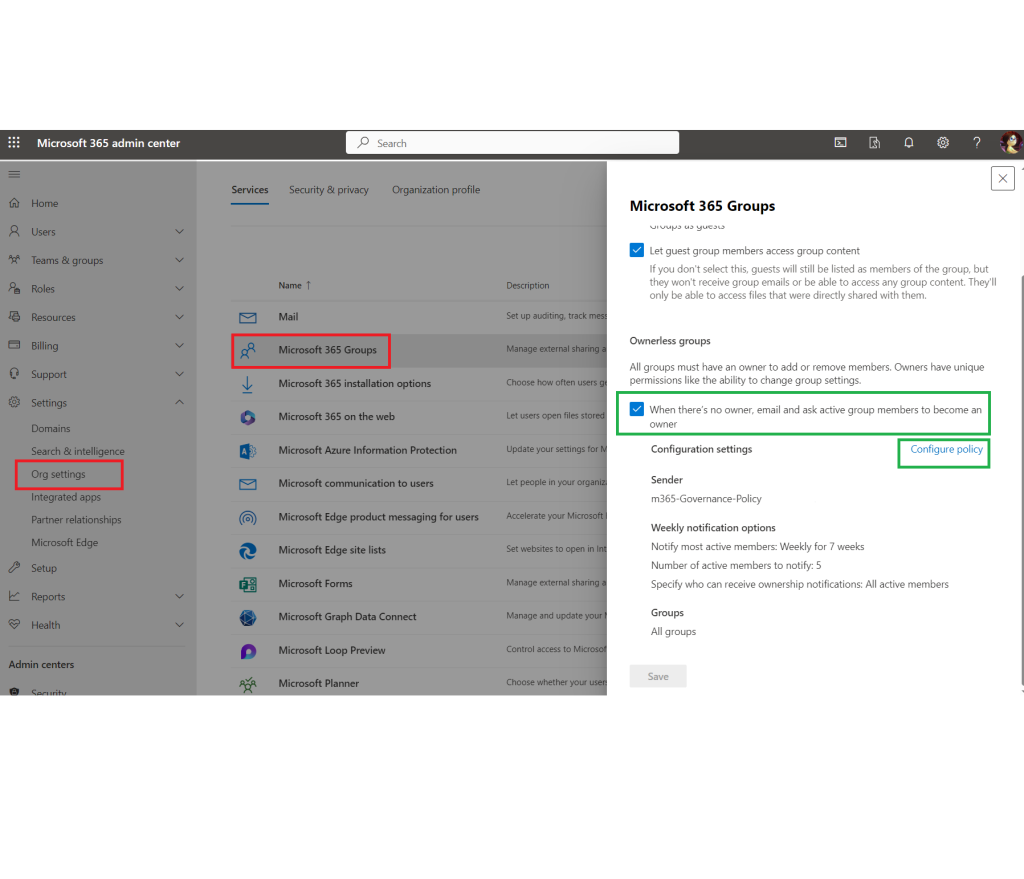
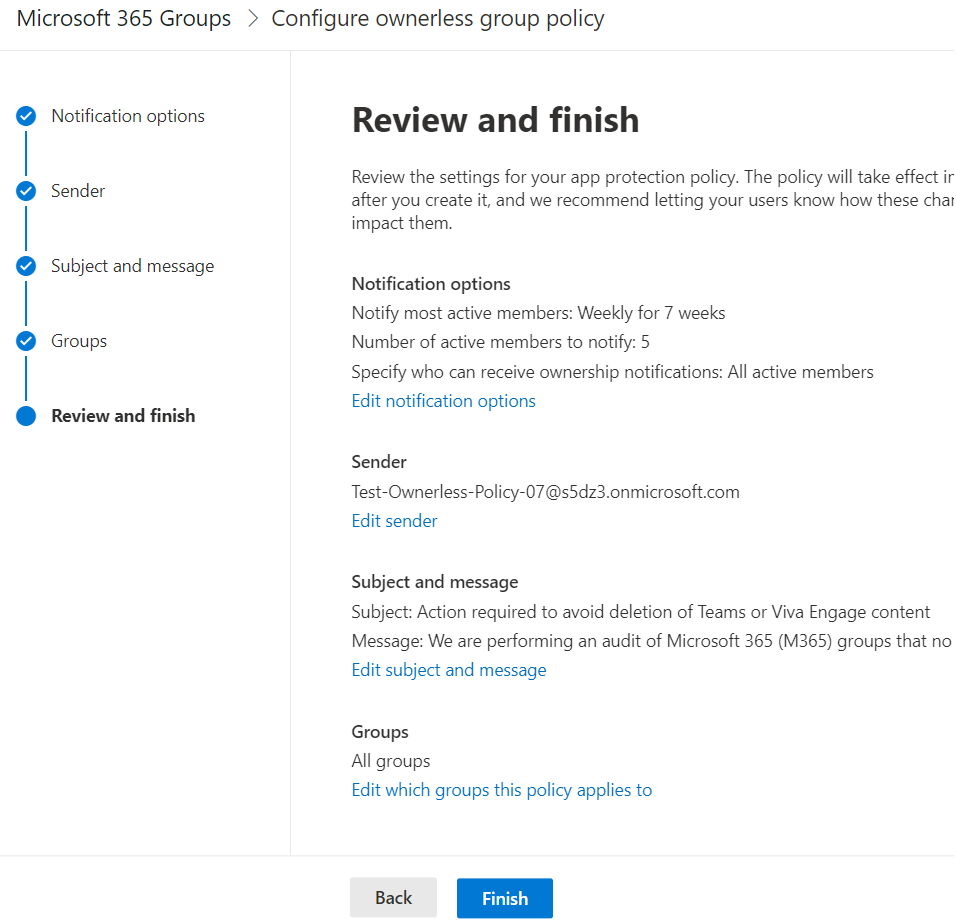
But based on the feature description – all looks exactly as what we already have for years as “Microsoft 365 ownerless groups policy” which you can configure under Microsoft 365 Admin Center -> Settings -> Org settings -> Microsoft 365 groups
As SharePoint or Teams admin you manage Microsoft 365 groups (create, update, delete, manage membership etc.) having your admin role activated. I prefer PowerShell 7 and Microsoft.Graph PowerShell module, and I need an Azure registered app with “Group.ReadWrite.All” Microsoft Graph API delegated permission.
Some findings:
If a user was not a group member or group owner – and the user is added to the group members – this user will get notification “You’ve joined the <Group Name> group” via e-mail that comes from a group e-mail address.
When a user is added to the group owners (or elevated to group owner if user was a group member) – user does not get notification.
When a user was a group owner and now you are adding this user to the group members – user does not get notification.
All the actions are logged into Microsoft 365 audit log under your personal Id.
Script samples:
# This script is just a sample to demonstrate basic technique on getting, updating groups membership and deletion m365 groups with PowerShell and MS Graph
#
# please do not run this script as is, but update it based on your needs

# authentication with personal Id
#  app must have as minimum "Group.ReadWrite.All" Microsoft Graph API delegated permission
#  user must have SharePoint admin (or Teams admin) roles activated
Connect-MgGraph -ClientId $clientid -TenantId $tenantId
Get-MgContext | Select-Object Scopes -ExpandProperty Scopes

# sample data
$groups = @()
$groups += [PSCustomObject]@{GroupId = '443d22ae-683a-4fe4-8875-7bd78227a026' }
$groups += [PSCustomObject]@{GroupId = 'e5805388-c18c-48c0-b42d-6223cf8f3d82' }

# Get Groups
foreach ($group in $groups) {
    Get-MgGroup -GroupId $group.GroupId
}

# add members to the group
$groupId = '443d22ae-683a-4fe4-8875-7bd78227a026'
$userId = 'df74e0d3-d78c-495b-b47a-549437d93cf7' # Adele
New-MgGroupMember -GroupId $groupId -DirectoryObjectId $userId

# add Owner to the group
$groupId = '443d22ae-683a-4fe4-8875-7bd78227a026'
$userId = 'eacd52fb-5ae0-45ec-9d17-5ded9a0b9756' # Megan
New-MgGroupOwner -GroupId $groupId -DirectoryObjectId $userId

# Delete group
$groupId = '443d22ae-683a-4fe4-8875-7bd78227a026'
Remove-MgGroup -GroupId $groupId